
This is a cake that belongs to the warm, citrus-scented kitchens of the Mediterranean rather than to the world of butter and cream. It carries no flour at all, leaning instead on ground almonds for richness and fine polenta for its distinctive golden crumb and gentle bite. Orange and lemon run through every mouthful, and the whole thing is bound together by good olive oil, which keeps it moist for days and gives it a savoury depth that butter could never manage.
It is the kind of cake to make on a quiet afternoon and eat slowly, warm from the tin, with a spoonful of crème fraîche softening into the sponge. Simple to assemble and forgiving to bake, it rewards good ingredients above all else.
Why the olive oil matters
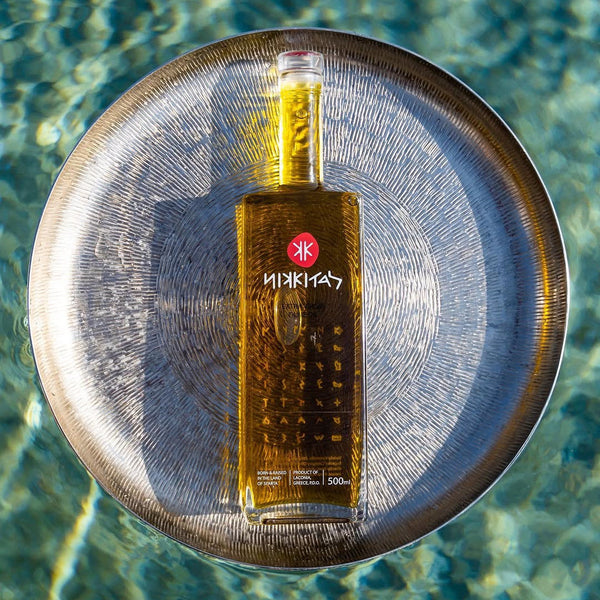
Olive oil is the backbone of this cake, not a substitute for butter but a better choice for the job. A fruity extra virgin oil, such as the single-estate Nikkitas pressed in Sparta, carries the orange and lemon beautifully, lifting the citrus rather than muffling it as a heavier fat would. Its flavour is woven into the crumb instead of sitting on top of it.
Just as importantly, oil keeps the cake tender. Because it stays liquid at room temperature, it coats the almonds and polenta more thoroughly than solid butter, holding moisture in the sponge so that it remains soft and damp for several days. Choose an oil you are happy to taste, as its character will come through clearly in the finished cake.
Ingredients
- 200ml Nikkitas Extra Virgin Olive Oil, plus extra for greasing
- 200g caster sugar
- 3 large eggs
- Zest and juice of 2 oranges
- Zest of 1 lemon
- 200g ground almonds
- 100g fine polenta
- 1½ tsp baking powder
- A pinch of fine salt
- Icing sugar, to dust
- Crème fraîche or Greek yoghurt, to serve
Made this way, with ground almonds and polenta in place of wheat flour, the cake is naturally gluten-free. If you do need to keep it strictly so, check that your polenta and baking powder are certified free from cross-contamination. The recipe scales cleanly: doubled into two tins it holds its texture well, and the ratio of almonds to polenta is the part to keep fixed if you adjust the size.
Equipment
- A 23cm round cake tin
- Baking parchment for lining the base
- A large mixing bowl and a balloon whisk
- A fine grater or microplane for the zest
- A spatula for folding
- A skewer for testing, and a wire rack for cooling
Method
- Prepare the tin and oven. Preheat the oven to 180°C (fan 160°C) and grease a 23cm round tin with a little olive oil, then line the base with parchment. A moderate oven lets the dense, almond-rich batter cook through to the centre before the outside overcolours.
- Build the base. Whisk the olive oil and caster sugar together in a large bowl until combined. Beat in the eggs one at a time, then stir in the orange juice and both zests. Adding the eggs gradually keeps the mixture smooth and emulsified, so the oil does not separate out, while the zest releases its fragrant oils into the batter.
- Fold in the dry ingredients. Fold in the ground almonds, polenta, baking powder and salt until you have a smooth, glossy batter. Folding rather than beating protects the lift from the baking powder and stops the crumb turning tough.
- Bake. Pour into the prepared tin and bake for 35 to 40 minutes, until deep golden and a skewer inserted into the centre comes out clean. If it colours too quickly, cover loosely with foil for the last 10 minutes so the top does not scorch before the middle is set.
- Cool and finish. Leave to cool in the tin for 15 minutes, then turn out onto a wire rack. Resting in the tin lets the moist, fragile crumb firm up enough to hold together when released. Dust with icing sugar and serve warm or at room temperature with a generous spoonful of crème fraîche.
Chef's notes and common mistakes
- Do not overbake. The almonds and polenta hold a lot of moisture, and the cake can read as underdone when it is in fact perfect. Trust the skewer test rather than the clock, and pull it the moment it comes out clean.
- Zest before you juice. It is far easier to grate the zest from a whole, firm fruit than from a squeezed one. Take all the zest first, then halve and juice.
- Mind the polenta grade. Use fine polenta, not the coarse kind, which stays gritty in a cake. If only coarse is available, a brief blitz in a grinder brings it closer to the right texture.
- Let it settle. The flavour deepens and the crumb improves a few hours after baking, so this is a cake that gives its best a little after it leaves the oven.
Variations
The citrus is open to interpretation. Blood orange in season gives a rosier, more perfumed result, while a mixture of orange and pink grapefruit brings a pleasant bitterness. For something closer to a southern Italian table, swap the lemon zest for the finely chopped zest of a small mandarin. A handful of fresh rosemary needles or a teaspoon of fennel seed, crushed and folded through the batter, turns it in a more savoury, aromatic direction. You can also brush the warm cake with a simple syrup made from the reserved citrus juice and a little sugar for a wetter, more drenched crumb.
Make ahead and storage
This is a cake that improves with a day's rest, making it ideal to bake ahead. Once completely cool, keep it in an airtight tin at room temperature, where the olive oil will hold it moist for up to four days. It also freezes well, whole or in slices, wrapped tightly and kept for up to three months, then thawed at room temperature. Dust with fresh icing sugar only when you are ready to serve, as it dissolves into the surface over time.
Serving and pairing
Serve it warm or at room temperature, never fridge-cold, with a spoonful of crème fraîche or thick Greek yoghurt to set off the sweetness. A few segments of fresh orange alongside, or a scatter of chopped pistachios, make it feel more like a dessert. It is equally at home with afternoon coffee or an espresso, and a small glass of sweet dessert wine such as Vin Santo or a chilled Muscat is a fine match for its citrus and almond.