
An olive oil cake asks you to think differently about what a cake can be. Where butter sets firm and gives a close, tender crumb, oil stays liquid at room temperature, and a cake built on it keeps its moisture for days. The result is something lighter on the tongue and altogether more grown up, with a softness that lingers rather than a richness that sits heavily. This is a plain cake in the best Mediterranean sense, the kind kept under a cloth on the kitchen table and cut into whenever the moment calls for it.
The recipe below leans on lemon zest and a generous pour of good olive oil, with a little melted butter for backbone and just enough flour to hold the whole thing together. It is forgiving, quick to assemble, and rewards patience only in the beating of the eggs. Master that one step and the rest follows easily.
Why the olive oil matters
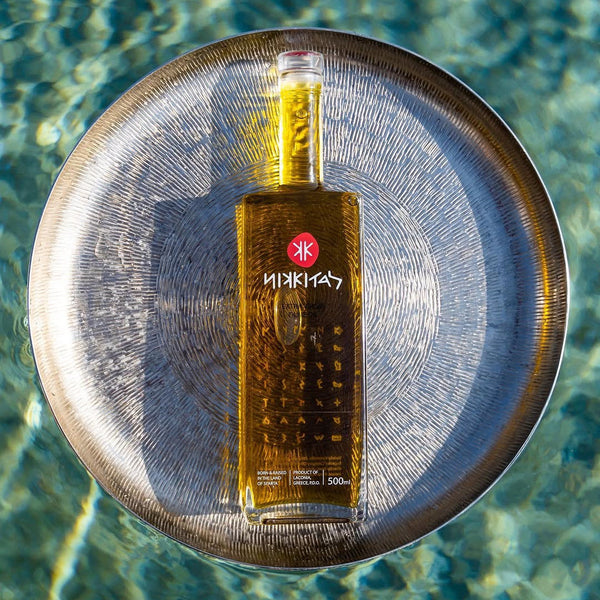
Here the oil is not a supporting player, it is the cake. Nikkitas Extra Virgin Olive Oil, pressed from a single estate near Sparta, brings a fruity, gently grassy character that carries through every bite without ever turning harsh. That balance is the whole point. A bitter, peppery oil can dominate a delicate crumb and leave a sharp finish, while a fruity, not-too-bitter oil lends moisture, a tender crumb, and a quiet savouriness that sits beautifully against the lemon and sugar.
Because the oil stays liquid as the cake cools, it coats the flour proteins and slows them from tightening, which is exactly why an olive oil cake feels so moist and keeps so well. Use an oil you would happily taste from a spoon, since whatever you pour into the batter is precisely what you will taste in the finished slice. A tired or rancid oil has nowhere to hide in a cake this honest.
Ingredients
- 4 medium eggs, at room temperature
- 200g caster sugar
- Zest of 1 lemon, finely grated
- 1 tbsp whole milk
- 100g unsalted butter, melted and slightly cooled
- 240g plain flour
- 2 tsp baking powder
- 180ml Nikkitas Extra Virgin Olive Oil
- Icing sugar, to dust
A note on quantities and substitutions: the cake scales cleanly, so a 1.5 batch baked in a larger tin will serve a crowd, though you will need to add a few minutes to the baking time and test with a skewer. Caster sugar gives the finest crumb, but golden caster sugar will work and bring a faint caramel note. If you have no whole milk to hand, a semi-skimmed splash is fine. The one thing not to economise on is the olive oil, which defines the cake.
Equipment
- A 23cm round cake tin, greased
- A stand mixer, or a hand mixer with a large bowl
- Two mixing bowls
- A fine sieve for the flour
- A fine grater or microplane for the lemon zest
- A skewer or thin knife for testing
- A wire rack for cooling
Method
- Heat the oven and prepare the tin. Preheat to 175°C, 160°C fan, gas 4, and grease a 23cm round cake tin. A moderate oven lets the cake rise steadily and bake through to the centre before the outside darkens, which matters in a batter this rich with oil.
- Sift the dry ingredients. Sift the flour and baking powder into a bowl and set aside. Sifting aerates the flour and disperses the raising agent evenly, so the cake lifts uniformly rather than in patches.
- Combine the liquid fats. In a second bowl, whisk the melted butter, milk and olive oil together until smooth. Bringing the fats together first means they fold into the batter evenly and will not pool or streak when added later.
- Beat the eggs and sugar. In the bowl of a stand mixer, beat the eggs, sugar and lemon zest on medium-high for 4 to 5 minutes, until pale, thick and creamy. This is the only structural lift the cake gets, so do not rush it. The air you whip in now is what gives the crumb its lightness.
- Fold in alternately. Reduce the speed to low and add the flour mixture in three additions, alternating with the oil mixture in two. Mix only until smooth. Alternating keeps the batter stable and stops the flour from clumping, while stopping the moment it comes together protects the airy structure you just built. Overmixing develops the gluten and toughens the crumb.
- Bake. Pour into the prepared tin and bake for 30 to 35 minutes, until golden and a skewer inserted into the centre comes out clean. The skewer is your only reliable guide, as colour alone can mislead.
- Cool and finish. Cool in the tin for 10 minutes, then turn out onto a wire rack to cool completely. Resting in the tin lets the crumb firm enough to release cleanly. Dust with icing sugar just before serving, since it will dissolve into a damp cake if applied too soon.
Chef's notes and common mistakes
- Do not shortcut the egg beating. The 4 to 5 minutes of whisking is the cake's entire leavening backstop alongside the baking powder. Stop early and you risk a dense, low loaf.
- Use room-temperature eggs. Cold eggs whip to less volume and can seize the melted butter into specks. Take them out half an hour ahead, or warm them briefly in a bowl of tepid water.
- Resist overmixing once the flour goes in. Fold only until no streaks remain. Every extra turn builds gluten and trades tenderness for chew.
- Trust the skewer, not the clock. Ovens vary, and a 23cm cake can need a few minutes either side of the stated time. Begin checking at 30 minutes and pull it the moment the skewer comes out clean.
Variations
This is a quiet, adaptable cake that takes well to small additions. Swap the lemon zest for orange, or use both, for a rounder citrus note. A teaspoon of fennel seeds or a little chopped rosemary folded through the batter nods to the cake's Greek roots and plays against the savoury edge of the oil. For something closer to a pudding, a thin syrup of lemon juice and sugar spooned over the warm cake will soak in and intensify the moisture. A scattering of flaked almonds across the top before baking adds crunch and a toasted finish.
Make ahead and storage
An olive oil cake is one of the rare bakes that improves with a day's rest, as the oil continues to settle through the crumb and the flavour deepens. Stored under a cloth or in an airtight tin at room temperature, it keeps well for three to four days, growing if anything more tender. It also freezes cleanly: wrap the cooled cake, whole or in slices, and freeze for up to two months, then thaw at room temperature. Hold the icing sugar until just before serving, whenever that may be.
Serving and pairing
Serve in generous slices, plain with its dusting of icing sugar, or with a spoonful of Greek yoghurt and a few macerated berries alongside. For a pairing, a chilled glass of sweet Greek Muscat or a Vin Santo answers the lemon and the oil without overwhelming the cake's restraint. If you would rather keep things sober, a small cup of strong, dark coffee is the natural companion, its bitterness setting off the sweetness of the crumb just as it would at a table in Sparta.