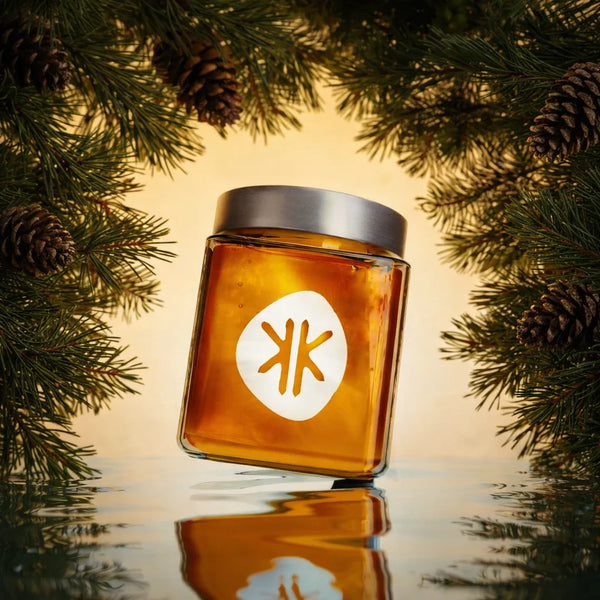

Some cakes hide their best ingredient inside the crumb, folded into the batter and lost to the heat of the oven. This one does the opposite. The honey is held back, then poured over the cake twice while it is still warm, so that it soaks down through the sponge and settles on top in a glaze that catches the light. It is a plain cake by design, a soft butter sponge built to carry the honey rather than compete with it.
The result is quietly remarkable. There is no spice, no citrus, no decoration to distract from the one flavour that matters. What you taste is the honey itself, deepened by the warmth of the cake and the gentle scorch of a second bake. Get the honey right and the rest follows.
Why the honey matters
This cake is, in the most literal sense, a vehicle for the honey. Four tablespoons are used, none of them in the batter. Two are poured over the part-baked cake so they sink in and perfume the crumb, and two are brushed over the finished sponge as it cools, where they set into a thin, glossy lacquer. With the honey doing so much of the talking, its character is the whole point.
Nikkitas Raw Pine Honey is well suited to the task. Pine honey is a honeydew honey rather than a floral one, darker and less sweet than the blossom honeys most people know, with a resinous, almost savoury depth and a slow, lingering finish. Because it is raw and unpasteurised, it keeps the aromatic compounds that heavier processing tends to drive off, and that aroma is exactly what the warm cake draws out. A pale, mass-market honey would simply read as sugar here. This one reads as flavour.
Ingredients
- 2 medium eggs
- 100 g caster sugar
- 100 ml whole milk
- 100 g unsalted butter, melted and slightly cooled
- 125 g plain flour
- 2 tsp baking powder
- 4 tbsp Nikkitas Raw Pine Honey, divided into two and two
- Extra butter and flour, for the tin
A note on quantities: the cake itself is forgiving and scales cleanly if you keep the proportions intact, though baking times will shift with a different tin. The honey, however, is the part to hold steady. Four tablespoons across the two stages is the balance that lets it soak and glaze without turning the cake wet, so resist the urge to drown it.
Equipment
- A 20 cm cake tin
- A mixing bowl and a whisk
- A sieve for the flour and baking powder
- A small saucepan or microwave-safe bowl for melting the butter
- A skewer for testing, and a pastry brush for the final glaze
- A wire rack
Method
- Prepare the tin and oven. Heat the oven to 180°C, 160°C fan, gas 4, and butter and flour a 20 cm tin. The flour coating over the butter gives the cake something to grip as it rises and releases it cleanly afterwards.
- Whisk the eggs and sugar. Beat the eggs and caster sugar together until smooth and pale. This dissolves the sugar and works a little air into the mixture, which is the only lift the cake gets beyond the baking powder.
- Add the wet ingredients. Pour in the milk and the melted butter and whisk to combine. Let the butter cool slightly first so it does not cook the eggs on contact.
- Fold in the dry ingredients. Sift the flour and baking powder over the bowl and fold until just incorporated. Stop the moment the flour disappears. Overworking the batter develops the gluten and trades a tender crumb for a tough one.
- Bake for the first stage. Pour the batter into the tin and bake for 20 minutes. The cake needs to be set enough on top to hold the honey without sinking, but not yet finished.
- Add the first honey. Take the cake out and pour 2 tablespoons of pine honey evenly over the surface, letting it soak in. Working while the cake is hot and open is what lets the honey travel down into the crumb rather than sitting on top.
- Bake for the second stage. Return the cake to the oven for a further 10 minutes. This sets the honey-soaked crumb and gives the surface a faint, fragrant caramelisation.
- Glaze and cool. Take the cake out and brush the remaining 2 tablespoons of honey over the top, then leave it to cool in the tin. As the cake cools the glaze tightens to a soft shine, and resting it in the tin keeps the still-tender sponge from breaking.
Chef's notes and common mistakes
- Do not skip the first honey soak. It is tempting to pour all four tablespoons over at the end, but the mid-bake soak is what carries honey into the cake rather than leaving it on the surface.
- Mind the melted butter. If it goes in too hot it will scramble the eggs and streak the batter. Warm, not hot, is the rule.
- Fold, do not beat, the flour. A heavy hand at this stage is the most common cause of a dense, rubbery sponge.
- Let it cool in the tin. The cake is fragile while warm and honey-soaked. Turning it out too soon is how it tears.
- Warm the honey if it has crystallised. Raw honey naturally sets over time. Stand the jar in warm water to loosen it so it pours and brushes evenly.
Variations
The plainness of this cake is its strength, but it takes gently to small changes. A different Nikkitas raw honey will shift the whole character of the cake: thyme honey brings a brighter, more herbal note, while a flowers and conifers honey leans softer and more floral. A pinch of ground cinnamon or a little lemon zest folded into the batter gives a warmer, more aromatic version, though both step slightly in front of the honey rather than behind it. For a richer crumb, swap a third of the plain flour for ground almonds.
Make ahead and storage
This is a cake that improves with a few hours' rest, as the honey continues to settle through the crumb. Once fully cool, keep it in an airtight tin at room temperature, where it stays moist for three to four days thanks to the honey, which holds onto moisture. It is not a cake for the fridge, which dries sponge and dulls the glaze. It freezes well wrapped tightly for up to a month, though it is best glazed fresh, so freeze it before the final brush of honey and add that once it has thawed.
Serving and pairing
Serve it in plain slices, just as it is, with nothing more than a second drizzle of pine honey if you are feeling generous. The natural partner is tea. A pot of strong black tea, an Assam or a good builder's brew, stands up to the honey, while a green tea or a lighter Earl Grey draws out its resinous edge. For coffee, keep it black and unfussy: an espresso or a plain filter lets the honey through where milk would only muffle it. A spoonful of thick Greek yoghurt alongside turns a teatime slice into a quiet pudding.