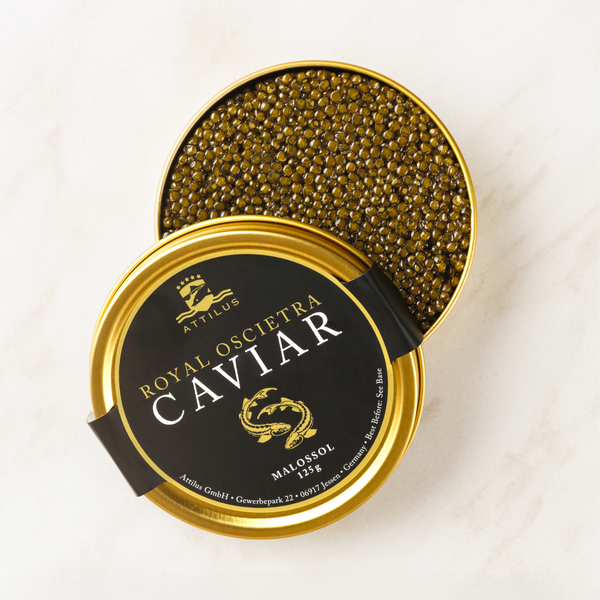

There are pasta dishes that announce themselves with garlic and chilli, and there are pasta dishes that whisper. This is firmly the second kind. Fresh tagliolini, a sauce of crème fraîche loosened with champagne and softened shallot, and a final, unhurried spoonful of Attilus caviar. It is the sort of plate that looks effortless and depends entirely on restraint.
The trick is to do less than you think. The sauce should barely cling, the pasta should be cooked seconds short of soft, and the caviar should never meet the heat of the pan. Get those three things right and you have one of the most elegant bowls of pasta in the Italian repertoire, built from a handful of ingredients and a little nerve.
Why the caviar matters
Caviar is not a garnish here, it is the dish. Attilus Royal Oscietra brings a clean, buttery, faintly nutty salinity, and pearls with a firm, glossy pop that you want to feel intact against the silk of the sauce. That pop is fragile. Heat dulls the flavour, slackens the membrane, and turns those distinct beads into a grey, weeping smear. Everything in this recipe is arranged to protect it: the caviar goes in last, off the heat, at the table.
Treat it accordingly. Keep the tin well chilled until the moment of serving, nested in ice if you have it, and spoon it with mother-of-pearl, bone, or horn rather than metal. Metal taints the delicate flavour with a faint tinny edge that you will notice the instant you taste it. The pearls are sustainably farmed and worth every gram of care you give them.
Ingredients
- 200g fresh tagliolini, or thin tagliatelle
- 40g to 60g Attilus Royal Oscietra Caviar, served as generously as you dare
- 150ml crème fraîche, full fat
- 30g unsalted butter
- 1 small shallot, very finely minced
- 60ml dry champagne, or a dry white wine
- Sea salt and white pepper, white pepper to keep the sauce clean and pale
- Chives, finely chopped, to garnish
A note on quantities: this serves two as a refined starter or a light main. The recipe scales cleanly, so keep the crème fraîche and shallot in proportion to the pasta and let the caviar be as lavish as the occasion allows. Champagne is the classic choice for the reduction, but any genuinely dry white wine will do the same work. Avoid anything off dry or oaky, as residual sweetness fights the salinity of the caviar.
Equipment
- A large pot for the pasta
- A wide, shallow pan or skillet for the sauce
- A sharp knife and board for the shallot and chives
- Tongs, and a heatproof cup for the reserved pasta water
- A non-metallic spoon (mother-of-pearl, bone, or horn) for the caviar
- Two warm bowls for serving
Method
- Get the water going. Bring a large pot of well-salted water to a boil. Fresh pasta cooks in moments, so you want the water ready and waiting before the sauce is finished, not the other way around.
- Sweat the shallot. Melt the butter in a wide, shallow pan over a low heat. Add the minced shallot and sweat gently for three to four minutes until completely soft and translucent. Keep the heat low so the shallot turns sweet and silky rather than coloured. Any browning brings a harshness that has no place in a sauce this delicate.
- Reduce the champagne. Pour in the champagne and simmer until reduced by half, about two minutes. Reducing concentrates the wine and cooks off the raw alcohol, leaving a bright acidity that will cut the richness of the cream to come.
- Build the sauce. Stir in the crème fraîche and season with white pepper. Keep it warm over the lowest possible heat and do not let it boil. Crème fraîche can split if pushed too hard, and a gentle, barely trembling sauce stays glossy and smooth.
- Cook the tagliolini. Cook the pasta until just al dente, usually two to three minutes for fresh. Reserve a small cup of the starchy pasta water before draining, as it is the thing that lets you loosen the sauce without thinning its flavour.
- Marry pasta and sauce. Add the drained pasta to the sauce and toss to coat, adding a splash of pasta water if needed to loosen it to a sauce that just clings. Taste for salt now, gently, remembering that the caviar to follow carries its own seasoning. Divide between two warm bowls.
- Crown with caviar. At the table, and only at the table, spoon the caviar generously over each bowl using your non-metallic spoon. Scatter with chives and serve immediately. Never heat the caviar. Its place is on top, cool against the warm pasta, where every pearl stays whole.
Chef's notes and common mistakes
- Never let the caviar touch the heat. Folding it through a hot pan or stirring it into the sauce dulls the flavour and bursts the pearls. Spoon it on at the end, off the heat, and let the residual warmth of the pasta be the only heat it ever feels.
- Keep the sauce below a boil. Crème fraîche split by too high a heat turns grainy and oily. The lowest flame on your stove is the right one. If it threatens to bubble, pull it off entirely and let the pasta's warmth carry it.
- Season with a light hand. Between the wine, the cream, and the caviar, the dish is closer to fully seasoned than you expect. Taste before the caviar goes on, not after, and reach for the salt sparingly.
- Have everything ready before the pasta hits the water. Fresh tagliolini waits for no one. The sauce should be warm and the bowls warm before you drain, so the whole thing comes together in under a minute.
Variations
The bones of this dish welcome small, thoughtful changes. A squeeze of lemon or a little fine zest stirred into the sauce brightens it further, though go carefully so as not to overwhelm the caviar. A whisper of fresh dill alongside the chives leans the plate towards something more Northern and herbal. Some cooks finish with a few drops of good olive oil rather than chives for a glossier, rounder result. What does not change is the gentleness: no garlic, no chilli, nothing that shouts over the pearls.
Make ahead and storage
This is a dish to make and eat at once, but you can do most of the work ahead. The shallot can be softened and the champagne reduced in advance, then the crème fraîche stirred in and the sauce gently rewarmed when the pasta goes on. Chop the chives and have the bowls warming. The caviar should stay sealed and well chilled until the final moment and is never cooked or stored as a leftover. Assembled pasta does not keep well, as the sauce stiffens and the pearls suffer, so cook only what you intend to serve.
Serving and pairing
Serve this as a starter to set the tone for an occasion, or as a light main with nothing more than a crisp green salad alongside. For wine, stay with the bottle you cooked from: a dry, mineral champagne is the natural and most elegant match, its bright bubbles and saline edge echoing the caviar. If champagne feels like too much, a steely, unoaked white such as a Chablis or a fine Muscadet sur lie will sit just as happily against the richness of the cream. Keep it cold, keep it dry, and let the pearls have the last word.