
Baklava is a sweet of patience and ceremony. Across Greece it appears at weddings, at Christmas, at the close of a long lunch that no one wants to end, cut into small diamonds and offered with strong coffee. The pleasure of it lies in contrast: dozens of paper-thin layers of filo, shattering and golden, holding a spiced rubble of walnuts, all of it bound by a honeyed syrup that soaks slowly into every crease.
What turns a competent baklava into a memorable one is restraint with the syrup and reverence for the layering. The recipe below is written to give you both, along with the one rule that governs the whole dish: cold syrup meets hot pastry, never the other way around.
Why the honey matters
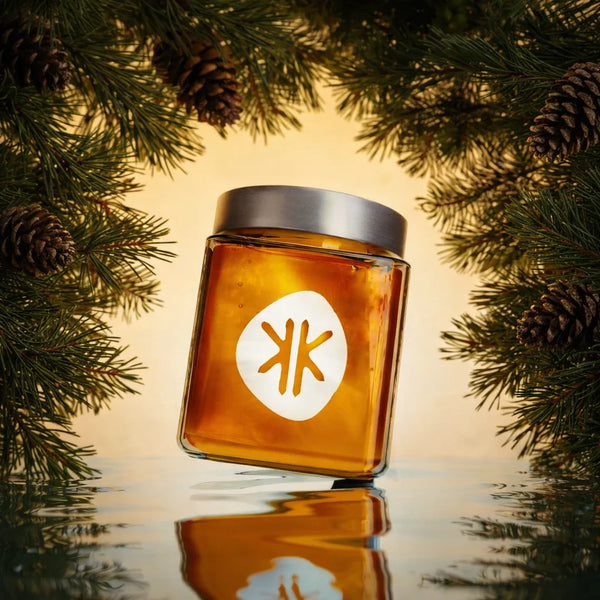
The syrup is where this dessert is won or lost, and honey is its heart. A raw, unpasteurised Greek honey such as Nikkitas Raw Flowers & Conifers Honey carries the resin and wildflower notes of the hillsides it comes from, a depth that pasteurised supermarket honey simply cannot offer. Heated only briefly and gently, it keeps its character and lends the finished baklava a floral, faintly piney warmth behind the sweetness.
There is a balance to strike. Sugar alone gives a syrup that is sweet but flat. Honey alone can turn cloying and heavy. The two together, in the proportions below, give a syrup that pours cleanly, sets to a gentle stickiness, and tastes of something rather than merely of sweetness. The better the honey, the less you need to dress the dish up with anything else.
Ingredients
- 270g unsalted butter, melted
- 400g filo pastry, thawed if frozen
- 400g walnuts, roughly chopped
- 1 tsp ground cinnamon
- ¼ tsp ground cloves
- A pinch of fine salt
- 300g Nikkitas Raw Flowers & Conifers Honey, for the syrup
- 150ml water
- 150g caster sugar
- 1 tsp rose water (optional)
A note on quantities and scaling: this fills a 30 by 23cm dish and yields 24 small pieces, which is the traditional serving size for something this rich. The recipe scales cleanly if you keep the nut, butter, and syrup proportions intact. If you cannot find walnuts you are happy with, a blend of walnuts and pistachios is entirely authentic across the eastern Mediterranean, though pure walnut is the Greek standard.
Equipment
- A 30 by 23cm baking dish, metal or ceramic
- A pastry brush, the wider the better
- A small saucepan for the syrup
- A sharp knife for scoring and cutting
- A bowl for the nut mixture and a small bowl for the melted butter
- A damp tea towel to keep the filo from drying out as you work
Method
- Prepare the oven and dish. Preheat the oven to 180°C, or 160°C fan. Brush the baking dish with melted butter. A well-buttered base stops the bottom layers catching and helps them crisp rather than steam.
- Mix the filling. Combine the chopped walnuts, cinnamon, cloves, and a pinch of salt in a bowl. The salt is small but deliberate: it sharpens the spice and keeps the sweetness from running away with the dish.
- Lay the first layers. Trim the filo sheets to fit the dish. Layer eight sheets in the base, brushing each one generously with butter before the next goes down. Buttering every single sheet is what creates the distinct, shattering layers; skip it and the pastry fuses into something dense.
- Build the middle. Spread half the nut mixture evenly over the pastry. Add six more buttered filo sheets, then the remaining nuts, then finish with the rest of the filo, again buttering every layer as you go. Keep the unused filo under a damp towel throughout, as it dries and cracks within minutes of exposure to air.
- Score before baking. With a sharp knife, score the top into diamonds or squares, cutting down through the upper layers but not quite to the base. Scoring now, while the pastry is soft, lets the syrup find its way in later and means clean pieces rather than a shattered mess once it is baked and brittle.
- Bake. Bake for 45 to 50 minutes, until deeply golden and crisp all the way across the top. Pale baklava is underbaked baklava; you want a confident colour.
- Make the syrup while it bakes. Bring the honey, water, and sugar to a gentle boil, stirring until the sugar dissolves, then simmer for 10 minutes. Stir in the rose water if using. Take the syrup off the heat and let it cool while the baklava finishes, so it is no longer hot when the two meet.
- The critical step. The moment the baklava comes out of the oven, pour the cooled syrup evenly over the hot pastry. This is the rule that makes or breaks the dish: cold or cool syrup onto hot pastry. The contrast lets the syrup soak in and keeps the filo crisp. Pour hot syrup over hot pastry and you steam the layers into a soggy block.
- Rest. Leave at room temperature for at least two hours before serving, longer if you can. The syrup needs time to travel through every layer and settle. Cutting too soon gives you a dry top and a flooded base.
Chef's notes and common mistakes
- Cold syrup, hot pastry, always. If you remember one thing, remember this. Matching temperatures, hot on hot or cold on cold, is the most common cause of soggy baklava.
- Butter every sheet. It is tedious and it is the whole point. The layers exist because of the butter between them.
- Do not underbake. The filo must be properly crisp and golden before the syrup goes on, because it will not crisp further afterwards.
- Keep the filo covered. A damp towel over the stack as you work is the difference between pliable sheets and a pile of cracked shards.
- Resist cutting early. The two-hour rest is not optional. The syrup needs to find its way to the base.
Variations
Walnut is the classic Greek choice, but the eastern Mediterranean offers honest alternatives. A blend of walnuts and pistachios, or pistachios alone, gives a greener, more delicate result. A little grated orange or lemon zest stirred into the nuts brightens the spice. The rose water is optional and divides opinion; orange blossom water is an equally traditional substitute, or you can leave both out and let the honey speak for itself. What does not change is the structure: thin layers, generous butter, and a syrup poured at the right moment.
Make ahead and storage
Baklava is, by its nature, a make-ahead sweet. It is arguably better on the second day than the first, once the syrup has fully settled. Store it covered at room temperature, not in the refrigerator, where the cold dulls the flavour and softens the crunch. Kept somewhere cool and dry, it holds its texture well for up to a week, and many would say it improves over the first few days. It also freezes successfully, baked and syruped, for up to three months; bring it back to room temperature before serving.
Serving and pairing
Serve baklava in small pieces, as it is meant to be eaten: a single rich diamond is enough. The traditional accompaniment is a cup of strong, unsweetened coffee, Greek or otherwise, whose bitterness cuts cleanly through the honeyed sweetness. If you prefer to end an evening with a glass rather than a cup, a chilled dessert wine suits it beautifully. A Greek Samos Muscat, with its own honeyed, floral character, is the natural match and echoes the honey in the syrup. A small glass of either, alongside the pastry, is how to close a long meal in no hurry to end.