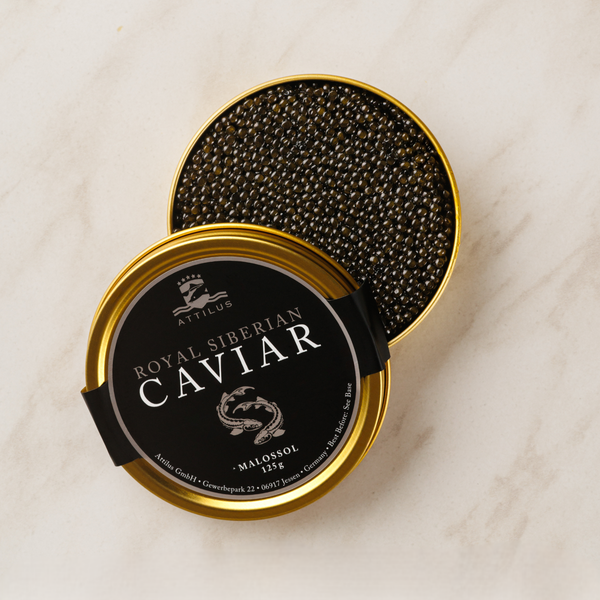

Of all the ways to eat well, few are as quietly theatrical as caviar service. There is no sauce to reduce, no roast to time, no last-minute panic. There is only good caviar, a handful of honest accompaniments, and the small ceremony of bringing them to the table at exactly the right temperature. Done properly, it is the most generous dish a host can offer and among the simplest to execute.
This is caviar in its classic register: warm buckwheat blinis, a cool spoonful of crème fraîche, and a crown of Attilus Royal Siberian caviar, the tin nested in crushed ice. The blinis ask for a little patience, but everything else is assembly and restraint. The finest caviar needs very little adornment, and the whole of this article is written to help you let it speak.
Why the caviar matters
Caviar is the one ingredient here that cannot be improved by technique, only honoured or wasted. Attilus farm their sturgeon sustainably, and the Royal Siberian is prized for clean, firm pearls that pop gently against the palate and release a buttery, faintly nutty brine. That delicacy is precisely why it is served on its own terms: well chilled, untouched by heat, and lifted with a spoon that will not interfere with it.
The cardinal rule is the spoon. Never use metal, which reacts with the roe and lends it a tinny, metallic taint that flattens the flavour you paid for. A spoon of mother-of-pearl, bone, or horn is traditional and entirely neutral, and once you have tasted the difference you will not go back. The blinis and crème fraîche are a frame around the caviar, not a disguise for it, so keep them gentle and let the pearls remain the point.
Ingredients
- 50g to 100g Attilus Royal Siberian caviar (25g per person is generous)
- 150g crème fraîche
- 20g unsalted butter, melted, plus extra for cooking
- Finely snipped chives, to garnish
For the blinis:
- 125g buckwheat flour
- 125g plain flour
- 1 tsp fast-action yeast
- 1 tsp caster sugar
- 250ml warm whole milk
- 2 large eggs, separated
- ½ tsp fine salt
A note on quantities: the blini batter here makes plenty for four and scales cleanly, so treat it generously. The caviar is the variable to judge by appetite and occasion. Allow 25g a head for a proper sitting, or stretch a single 50g tin across more guests if it is one indulgence among several courses. Buckwheat is traditional and gives the earthy, faintly bitter note that flatters caviar, but if you cannot find it, an all plain-flour batter still makes a fine pancake.
Equipment
- A large mixing bowl for the batter
- A whisk and a second clean bowl for the egg whites
- A non-stick frying pan
- A pastry brush for the butter
- A serving platter, plus a shallow dish or bowl of crushed ice to nest the tin
- A mother-of-pearl, bone, or horn spoon for the caviar, never metal
Method
- Mix the batter. Combine the buckwheat flour, plain flour, yeast, sugar and salt in a large bowl. Make a well in the centre and whisk in the warm milk, egg yolks and melted butter until smooth. The warmth of the milk wakes the yeast, so it should be blood-warm rather than hot, which would kill it.
- Prove the batter. Cover the bowl and leave it in a warm place for 20 minutes, until slightly puffed and lively on the surface. This short prove is what gives a good blini its tender, open crumb rather than a flat, dense disc.
- Fold in the whites. Whisk the egg whites to soft peaks and fold them gently into the batter in two additions. Folding rather than beating keeps the air you have just whisked in, and the two-stage approach loosens the batter before the bulk goes in, so you lose less volume.
- Cook the blinis. Heat a non-stick pan over a medium heat and brush with a thin film of butter. Drop tablespoons of batter into the pan and cook for one and a half to two minutes, until bubbles break across the surface. Flip and cook for a minute more. The bubbles are your signal that the underside is set and the blini is ready to turn.
- Keep them warm. Hold the cooked blinis under a clean cloth or in a low oven while you work through the rest of the batter. They are at their best warm, when their softness contrasts with the cold caviar and cooler crème fraîche.
- Assemble. Arrange the warm blinis on a platter or individual plates. Add a small spoonful of crème fraîche to each, then crown with caviar using your mother-of-pearl or non-metallic spoon. A light hand with the crème fraîche keeps it from swamping the pearls.
- Serve over ice. Set the caviar tin into a bowl of crushed ice and bring it to the table alongside, so it stays well chilled throughout. Scatter the chives and encourage your guests to eat at once. Caviar waits for no one.
Chef's notes and common mistakes
- Never let a metal spoon near the caviar. Metal reacts with the roe and leaves a tinny taint that ruins it. Mother-of-pearl, bone, or horn are the only spoons that belong at the table, and a clean plastic one will do in a pinch.
- Keep it cold, never warm. Caviar is served well chilled over crushed ice and is never cooked or heated. Take the tin from the fridge only when you are ready to serve, and return any leftovers to the cold at once.
- Do not over-dress. The blini and crème fraîche are a frame, not a sauce. A modest spoonful of each lets the caviar stay the centre of attention, which is the whole point of serving the finest roe.
- Mind the milk temperature. Blood-warm milk wakes the yeast; hot milk kills it and you will get flat blinis with no rise. If in doubt, err towards too cool rather than too hot.
Variations
The classic accompaniments are well worth knowing, and a traditional service often spreads several alongside the caviar so each guest builds their own bite. Finely chopped hard-boiled egg, white and yolk kept separate, a little minced shallot, and the snipped chives already called for here are the usual quartet, with crème fraîche the constant. Some prefer the caviar entirely unadorned, eaten straight from the spoon, and with roe of this quality that purist instinct is hard to argue with. The blinis themselves can be made small for canapés or larger for a plated starter, and a plain-flour batter is a perfectly good substitute if buckwheat is hard to come by.
Make ahead and storage
The blinis are the only component that rewards advance work. They can be cooked a few hours ahead and warmed through gently before serving, or frozen between sheets of greaseproof paper and reheated from frozen in a low oven. The caviar, by contrast, is best bought close to the day and kept in the coldest part of the fridge, sealed, until the moment of service. Once a tin is opened it should be eaten the same day for the cleanest flavour. Never freeze caviar, which collapses the pearls, and never leave it out to come to room temperature.
Serving and pairing
The two classic partners for caviar are Champagne and chilled vodka, and both earn their place. A dry, crisp Champagne, brut or extra brut, cuts cleanly through the richness and refreshes the palate between bites, while well-frozen vodka, served in small measures, is the traditional Slavic accompaniment that frames the brine without competing with it. Keep glasses and bottle cold, serve the caviar over its bed of crushed ice, and resist the urge to add anything further. With caviar this good, the most luxurious thing you can do is leave it almost entirely alone.