
There are few more persuasive ways to open an evening than a tray of warm blinis, each one carrying a soft cloud of herbed cream cheese and a glossy spoonful of caviar. This is a canapé that looks like effort and tastes like luxury, yet it comes together in a quarter of an hour. The recipe below makes a single, generous serving of twelve, but it scales to a party with nothing more than a longer chopping board and a steadier hand.
The trick, if there is one, lies in restraint. The cream cheese should be lively with garlic and herbs but never loud, and the caviar should be the last thing to touch the plate, spooned on gently so the pearls stay whole. Get the balance right and each bite delivers warmth, freshness, and that unmistakable saline shimmer in turn.
Why the caviar matters
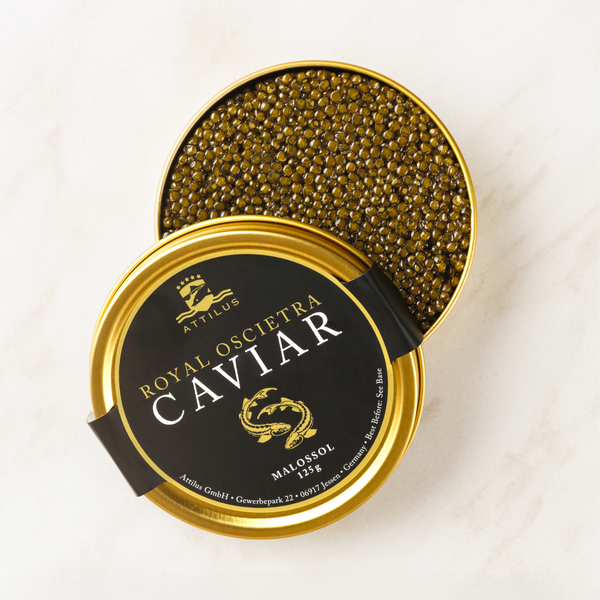
Caviar is the reason this canapé reads as an occasion rather than a snack. Attilus farm their sturgeon sustainably, and the care shows in the grain: firm, glossy beads that release a clean, briny butteriness rather than a flat salt hit. On something as simple as a blini, there is nowhere for poor caviar to hide, which is precisely why good caviar earns its place here.
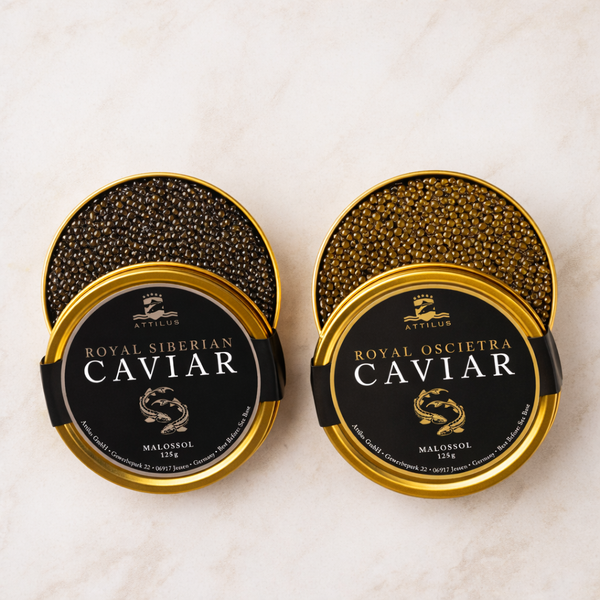
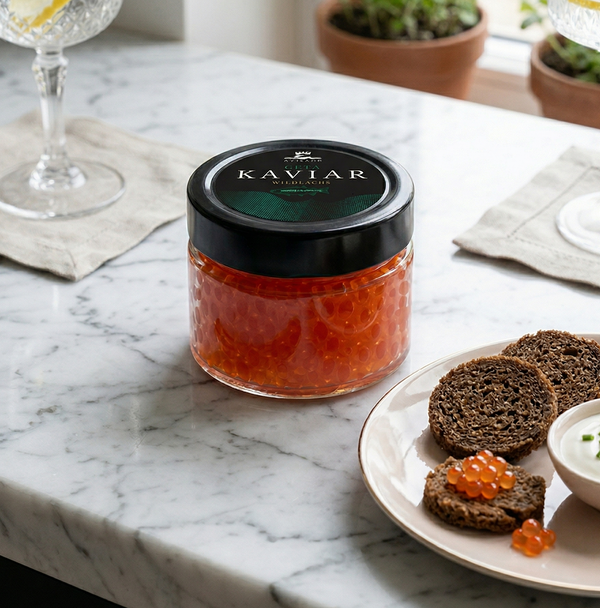
Treat it with the respect it deserves. Keep the tin well chilled until the last possible moment, and always serve with a mother-of-pearl, bone, or horn spoon rather than metal, which can lend the roe a tinny edge. Spoon the caviar on last and gently, letting it crown each blini without being pressed or stirred. Royal Oscietra is the classic choice, with its nutty depth, though a mix of black and salmon roe gives a pretty contrast of colour and a brighter pop.
Ingredients
- 12 small blinis or buckwheat pancakes, warmed
- 4 tbsp full-fat cream cheese, at room temperature so it spreads cleanly
- 1 small garlic clove, finely grated
- 2 tbsp mixed fresh herbs (dill, chives, parsley), finely chopped
- 2 tbsp Royal Oscietra caviar, or a mix of black and salmon roe
- 2 spring onions, finely sliced
- Fine sea salt and black pepper, to taste
A note on scaling: this serves one generously, but the ratios hold cleanly for a crowd. Count on three to four blinis per guest as a canapé, and multiply everything except the seasoning, which you should always judge by taste rather than arithmetic. For a party of twelve, a 50g tin of caviar spread across the tray is elegant; double it if you want each blini truly crowned.
Equipment
- A small mixing bowl
- A fine grater or microplane for the garlic
- A small palette knife or the back of a teaspoon for spreading
- A mother-of-pearl, bone, or horn spoon for the caviar (never metal)
- A serving platter or board
Method
- Mix the cream cheese. In a small bowl, beat the cream cheese with the grated garlic and chopped herbs until evenly streaked with green. Season with salt and pepper, then taste: it should be assertive but not overpowering, since it has to stand up to the caviar without competing with it. Grating the garlic rather than chopping it keeps the flavour even and avoids any raw, fibrous bite.
- Top the blinis. Spread a small spoonful of the herbed cream cheese on each blini, keeping it neat and not too thick. A modest layer gives the caviar something to sit on while letting the warmth of the blini come through.
- Add the caviar. Using your non-metallic spoon, add a small spoonful of caviar to each blini, roughly a quarter of a teaspoon, which is plenty. Set it down gently and do not spread it: the whole pleasure is in the beads bursting one by one, so they must stay intact.
- Garnish and serve. Scatter with the sliced spring onion for a fresh, faintly sharp lift, and serve immediately, while the blinis are still warm to the touch. The contrast of warm pancake and cold caviar is the point, and it fades the longer the tray waits.
Chef's notes and common mistakes
- Caviar goes on last, always. Build the blinis up to the cream cheese, then add the roe only when you are ready to serve. Sitting under a spoon of caviar for too long warms it and dulls its snap.
- Never use a metal spoon for the caviar. Metal can leave a faint metallic taste on the delicate roe. Mother-of-pearl, bone, or horn keep the flavour clean.
- Mind the salt. Caviar brings its own salinity, so go lightly when seasoning the cream cheese. It is far easier to add salt at the table than to rescue a tray that has gone over.
- Keep the cream cheese layer thin. Too generous a spread smothers both the blini and the caviar. You are looking for a cushion, not a wall.
Variations
The base invites gentle play. Swap the herbs to suit the season: tarragon for a faint aniseed note, or all dill for a more classically Nordic profile. A whisper of lemon zest in the cream cheese brightens everything and flatters salmon roe especially well. For colour and contrast on a party tray, alternate blinis topped with black Oscietra and others with salmon caviar, or crown a few with both. If you would rather make the blinis yourself, a buckwheat batter rested until puffed gives the most authentic, faintly sour pancake, though good shop-bought blinis are no shame at all.
Make ahead and storage
The herbed cream cheese can be made up to two days ahead and kept covered in the fridge, which actually helps the garlic and herbs settle into it. Bring it back to a spreadable temperature before using. The blinis can be warmed gently just before serving, in a low oven or a dry pan. What cannot be done ahead is the assembly: once topped, these are best within minutes, as the blinis lose their warmth and the caviar its chill. Keep the tin of caviar nested in crushed ice until the very last moment, and never freeze or reheat the roe.
Serving and pairing
These belong at the start of an evening, passed on a board with cold glasses in hand. Champagne is the classic partner for canapés like this, its acidity and fine bead cutting cleanly through the cream cheese while echoing the caviar's own delicacy. A blanc de blancs is particularly lovely here. If you would rather not pour Champagne, a well-chilled dry sparkling wine or an ice-cold shot of good vodka, served in the Russian manner, will both do the caviar proud.