Summary
Traditional balsamic vinegar is one of the most strictly regulated and time-intensive food products in the world. Produced exclusively in Modena, Aceto Balsamico Tradizionale di Modena DOP is made from a single ingredient - cooked grape must - and aged for a minimum of 12 years, or 25 years for the extra-aged version.
Its production follows legally defined Product Specifications enforced by law, ensuring that every phase, from grape selection to ageing, occurs within the Modena area under continuous oversight and strictly follows the production law.
Each batch must pass a formal sensory evaluation before being bottled in the official 100 ml container with a numbered seal, guaranteeing authenticity. The result is a dense, complex, and balanced condiment shaped by decades of evaporation, wood interaction, and careful stewardship.
Unlike commercial balsamic vinegars, traditional balsamic contains no wine vinegars, no additives, no colouring, and no shortcuts. It is a rare, slow-made product - both a culinary ingredient and a cultural artefact preserved across generations.
Introduction
To understand traditional balsamic vinegar is to understand time as an ingredient. Long before modern food systems standardised production, families in Modena were quietly refining a process that would span generations. What begins as freshly pressed grape must is slowly transformed - through cooking, fermentation, and decades of ageing - into something far more concentrated than vinegar in the conventional sense.
In its highest expression, Aceto Balsamico Tradizionale di Modena DOP producers operate within a strict regulatory framework. They are, in many respects, custodians of a living tradition - combining technical precision with experience, judgement, and intuition.
Even after decades of ageing, the product is not considered complete until it has been evaluated and approved by a panel of expert tasters. Only then is it sealed in the official 100 ml bottle, its numbered certification acting as a guarantee of authenticity - a final confirmation that what is inside meets the standards of a product often described as a work of art to be safeguarded.
100 ml of Traditional Balsamic in Context
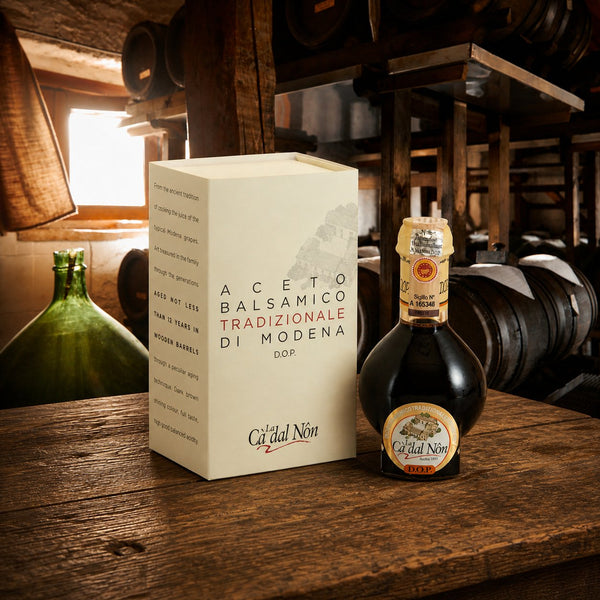
A 100 ml bottle of Traditional Balsamic Vinegar PDO is deceptively small. In reality, it represents years - often decades - of transformation.
The process begins with grapes grown exclusively in the province of Modena, primarily Trebbiano and Lambrusco varieties. These grapes are gently pressed to yield “free-run must,” the most fragrant and sugar-rich portion of the juice. From there, the must is slowly cooked over an open flame, concentrating its sugars and initiating the development of complex flavour compounds.
Over time, the liquid is transferred through a sequence of wooden barrels decreasing in volume, each contributing its own character while allowing a significant portion of the volume to evaporate.
The ageing technique is a solera: each year, the loss of liquid in the smallest barrel is compensated by part of the liquid from the previous and bigger barrel, and so on backwards to the biggest barrel of the line, where each year part of the new cooked grape must is poured. This technique, repeated year after year, shapes this unique product.
By the time the vinegar is ready for evaluation, what remains is a highly concentrated substance, dense, aromatic, and balanced in sweetness and acidity. Before bottling, it must pass the scrutiny of certified tasters. Only then is it sealed in the official 100 ml bottle with a numbered cap, ensuring both traceability and authenticity.
What is Traditional Balsamic Vinegar?

Traditional Balsamic Vinegar is a Protected Designation of Origin (PDO) product, meaning that its identity is inseparable from its place of origin and the methods used to produce it.
In the case of Aceto Balsamico Tradizionale di Modena DOP, the rules governing production are legally enforced standards designed to preserve the product’s integrity.
Only cooked grape must may be used. No wine vinegar, no caramel, no thickeners, and no additives of any kind are permitted. Every stage of production must take place within the Modena province, ensuring continuity between environment, raw material, and process.
Oversight is provided by the Consorzio Tutela Aceto Balsamico Tradizionale di Modena, which monitors compliance, protects against imitation, and guarantees transparency for consumers. Through continuous controls, the certification body ensures that the product maintains what are often described as its inimitable qualities - characteristics that cannot be replicated outside this specific context.
A History Measured in Centuries
The story of traditional balsamic vinegar stretches back over a millennium.
The Roman poet Virgil wrote about the practice of cooking grape must, while in the first century AD, Lucius Junius Columella described the transformation of cooked must into vinegar.
By the 11th century, the monk Donizone recorded the gifting of a prized vinegar by Marquis Boniface of Canossa to Henry II, who reportedly received it with great appreciation - an early indication of its prestige.
During the rule of the House of Este, balsamic vinegar became a symbol of refinement and status. It was offered as a diplomatic gift across European courts and valued not only for its flavour, but also for its perceived medicinal qualities.
Historical disruptions also shaped its story. In 1796, the Napoleonic army dismantled ducal vinegar lofts, auctioning barrels that had been maintained for generations. Later, during the unification of Italy, further losses occurred when collections were confiscated and relocated, with some disappearing entirely.
Despite these interruptions, the tradition endured within families and was eventually codified in the 19th century through the writings of Francesco Aggazzotti, whose detailed descriptions of production practices became the foundation for modern regulations.
Traditional Balsamic Vinegar of Modena vs Balsamic Vinegar of Modena vs Balsamic
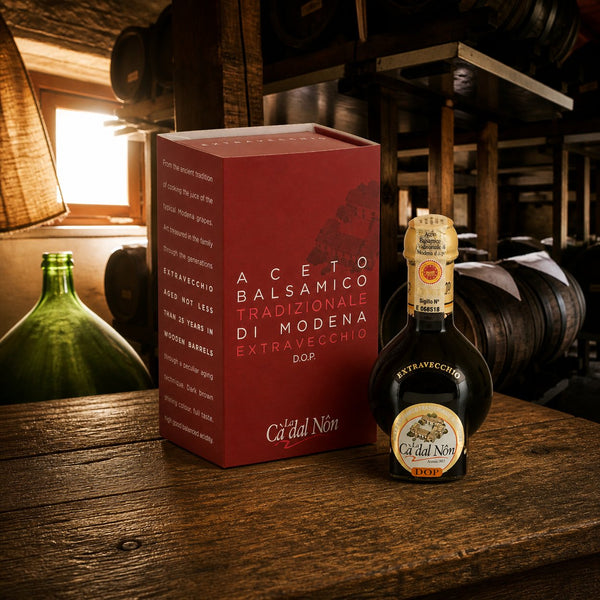
Traditional Balsamic Vinegar of Modena is a PDO product, obtained only from the natural vinegar fermentation of cooked grape juice from grapes grown and harvested in the province of Modena. The cooked grape must is then aged in a series of decreasing-volume barrels (traditionally called the batteria) through a solera technique for a minimum of 12 years, or a minimum of 25 years for the product designated Extravecchio (Extra-aged).
Balsamic Vinegar of Modena is a PGI product, obtained by blending cooked or concentrated grape must (min. 20%) with wine vinegar (min. 10%) and an undefined percentage of a vinegar aged at least 10 years. Up to 2% caramel may be added. The product is then seasoned for 60 days in wooden containers, with some versions aged for several more years in wood. The blending and seasoning must occur within the provinces of Modena and Reggio Emilia, though bottling may take place outside this area, and the origin of the ingredients is not required.
Other products generally called Balsamic are produced using different methods. They often combine wine vinegar with grape must and may include caramel colouring, flavours, or thickeners to achieve a desired appearance or texture. In this case, no specific regulation applies.
PDO vs PGI: a detailed comparison
| Feature | Traditional Balsamic Vinegar of Modena PDO | Balsamic Vinegar of Modena PGI |
|---|---|---|
| Protected Status | PDO (Protected Designation of Origin) | PGI (Protected Geographical Indication) |
| Ingredients | 100% cooked grape must from grapes grown in Modena and surrounding areas | Concentrated and/or cooked grape must (min. 20%), wine vinegar (min. 10%), and a percentage of vinegar aged at least 10 years |
| Grape Variety and Origin | Grapes must originate from Modena area; varieties strictly defined by production regulations | Permitted grape varieties defined by law, but grapes may originate outside Modena |
| Additives | No additives permitted | Caramel colouring permitted up to 2%; commercial products may also include stabilisers or thickeners |
| Production Method | Natural alcoholic and acetic fermentation followed by long ageing using the traditional solera system in progressively smaller wooden barrels | Blending and refinement in wooden barrels; more industrial and standardised production methods permitted |
| Barrel Ageing | Ageing in a series of barrels made from different woods (oak, chestnut, cherry, juniper, mulberry, etc.) which contribute complexity and aromatic depth | Wooden barrel refinement, but without the traditional multi-barrel solera ageing system |
| Production Location | Entire production process must take place in Modena | Refinement and ageing must occur in Modena or Reggio Emilia |
| Ageing Requirements | Minimum 12 years; minimum 25 years for Extra Vecchio / Extravecchio | Minimum 60 days; minimum 3 years for Aged; minimum 5 years for Riserva |
| Texture / Density | Naturally dense with appreciable smooth syrupiness developed through slow evaporation and concentration | Typically more fluid; thicker textures may result from concentration or additives |
| Colour | Dark brown and glossy | Intense brown, clear and bright |
| Aroma | Complex, fragrant, penetrating and persistent bouquet with harmonious acidity and layered wood-derived notes | Persistent, delicate and pleasantly acetic aroma, sometimes with woody notes |
| Flavour Profile | Deeply complex, balanced sweet-and-sour profile with velvety texture, integrated acidity, and subtle tannic notes from different woods | Balanced sweet-and-sour flavour, generally simpler, brighter and more direct |
| Sensory Character | Full, velvety, intense, persistent and highly harmonious | Pleasant, characteristic and approachable |
| Certification | Strict PDO controls including sensory panel approval and numbered seal | PGI certification with less restrictive production requirements |
| Bottle Format | Only official 100 ml bottle permitted | Multiple formats permitted: 0.100 l, 0.150 l, 0.200 l, 0.250 l, 0.500 l, 0.750 l, 1 l, 1.5 l, 2 l, 3 l or 5 l containers permitted; single-dose containers up to 25 ml; larger professional-use plastic containers |
| Permitted Packaging | Official glass bottle only | Glass, wood, ceramic, terracotta, plastic and composite containers permitted depending on format |
| Commercial Positioning | Artisanal luxury product with limited production and protected traditional methods | Commercially produced product intended for wider culinary and foodservice use |
| Typical Use | Finishing condiment used sparingly on premium dishes | Everyday use for dressings, marinades, cooking and glazing |
The Production Process: From Must to Masterpiece
The production of Traditional Balsamic Vinegar begins with careful grape selection. Only specific varieties grown within the Modena province are permitted, and the grapes must meet both qualitative and quantitative standards.
After pressing, the must is cooked slowly over an open flame. This stage is critical, as it determines the balance between sweetness, acidity, and aromatic development. The cooked must is then transferred to wooden casks where natural fermentation begins.
From there, the liquid enters the batteria: a sequence of progressively smaller barrels made from different woods. Each year, following the solera method and starting from the smallest barrel of the line, a small quantity of liquid is transferred from the previous and bigger barrel to the next, compensating for evaporation and gradually concentrating the vinegar, working backwards to the largest barrel of the line, where the loss of liquid is compensated by an amount of the new cooked grape must of the year.
This process continues for a minimum of 12 years, and often for more than 25. Throughout this time, the producer plays a central role, overseeing each transfer and making decisions based on experience and intuition, and actively shaping its outcome.
The Batteria and the Role of Wood

The batteria is at the heart of traditional balsamic production. Far from being passive containers, the wooden barrels actively influence the evolution of the vinegar.
Different woods contribute distinct characteristics - structural elements, aromatic compounds, and subtle variations in texture. Over time, the interaction between liquid, wood, and air creates a complex and harmonious profile that cannot be replicated through industrial methods.
These barrels are traditionally kept in attic spaces, where seasonal temperature fluctuations drive evaporation and concentration. The environment itself becomes part of the process, reinforcing the connection between product and place.
Flavour Profile and Sensory Characteristics
Traditional Balsamic Vinegar is defined by balance, intensity, and length.
Its sweetness is not added, but naturally derived from concentrated grape sugars. This sweetness is counterbalanced by acidity, creating a profile that is both rich and precise.
With ageing, the vinegar develops layers of flavour - dried fruit, wood, spice, and subtle aromatic notes that evolve on the palate. The texture becomes dense and velvety, while the finish remains long and persistent.
A balanced acidity develops too, giving character to the taste and contributing to its length and intensity.
What distinguishes it most is not intensity, but harmony - the integration of all elements into a single, cohesive experience.
Cultural Significance: A Living Heritage
For centuries, families in Modena have maintained vinegar lofts as repositories of knowledge and tradition. Barrels were passed down through generations, sometimes forming part of a family’s inheritance or dowry.
These spaces - quiet, atmospheric, and deeply personal - remain central to the identity of the product. Visiting one is often described as stepping back in time, entering an environment where the past is preserved in living practice.
How to Identify Authentic Traditional Balsamic
Authenticity in traditional balsamic vinegar is defined by strict, verifiable criteria. The presence of the PDO designation is essential, confirming that the product complies with regulated standards. Equally important is the official 100 ml bottle, which is used exclusively for certified traditional balsamic and sealed with a numbered cap.
The ingredient list should contain only cooked grape must. Any additional ingredients indicate a different category of product. Age classifications provide further context, distinguishing between minimum 12 years of aging and extra-aged varieties. Together, these elements form a system designed to protect both the product and the consumer.
How to Use Traditional Balsamic

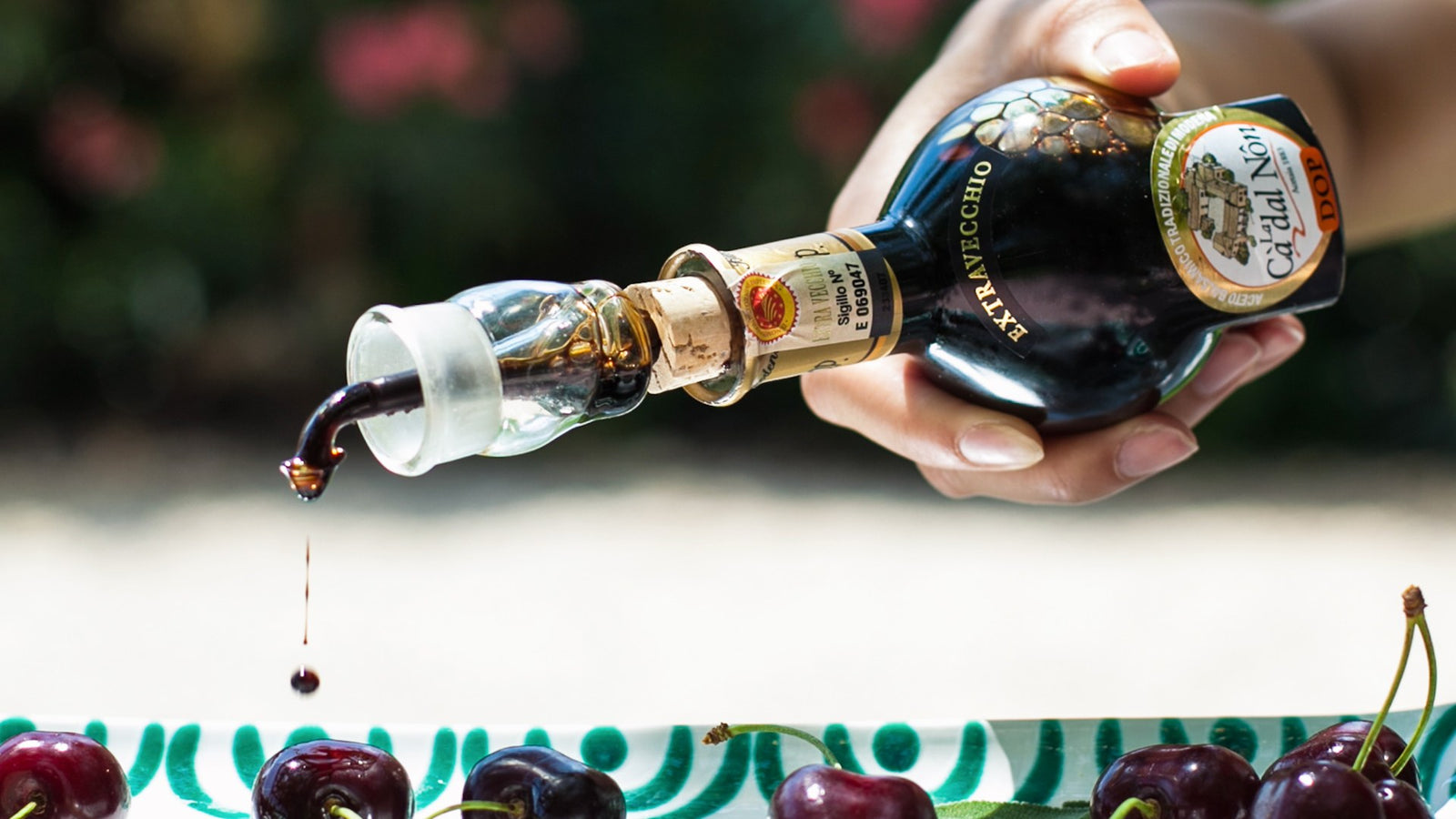
Traditional Balsamic Vinegar is highly concentrated and should be used sparingly, as a finishing element rather than a cooking ingredient. A few drops are enough to elevate a dish, it enhances flavour rather than dominating it:
- Cheese pairings: Drizzled over aged cheeses such as Parmigiano Reggiano
- Fruit: Added to strawberries, figs, pears, or peaches to enhance natural sweetness
- Risotto and pasta: Finished just before serving to preserve aroma and depth
- Meat and vegetables: Used on grilled meats or roasted vegetables for balance and complexity
- Egg dishes: A few drops over scrambled eggs or soft-boiled eggs
- Desserts: Paired with vanilla ice cream or panna cotta for contrast
In terms of storage, Traditional Balsamic Vinegar is naturally stable due to its acidity and concentration. It does not require refrigeration and can be stored at room temperature, provided it is kept sealed.
Conclusion
Traditional Balsamic Vinegar of Modena represents the convergence of time, place, and human expertise. Governed by strict production standards and protected by institutions such as the Consorzio Tutela Aceto Balsamico Tradizionale di Modena, it stands apart from industrial food products.
Its value lies not only in its flavour, but in the process that creates it - a process defined by patience, continuity, and respect for tradition.
In a world increasingly shaped by speed and scale, traditional balsamic remains deliberately slow. It is, in every sense, a product to be preserved - not just consumed.