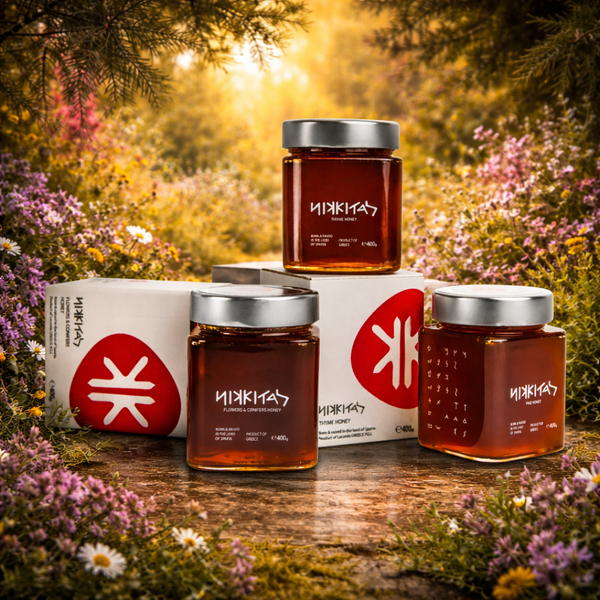
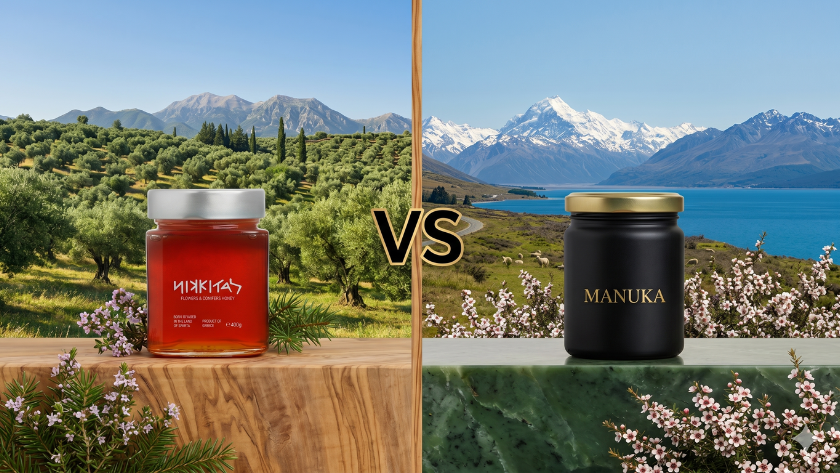
When comparing manuka honey with Greek thyme honey, the difference is not simply about which is “better,” but which delivers the type of benefit you actually need. Manuka honey is renowned for its laboratory-tested antibacterial potency, driven by its methylglyoxal (MGO) content and widely studied for topical applications. Greek thyme honey, on the other hand, offers high antioxidant density, balanced antimicrobial activity, and excellent everyday nutritional value. Understanding how manuka honey differs from thyme honey allows consumers to choose based on function, wellness goals, and long-term value - not marketing alone.
The Reputation of Manuka Honey
Few foods carry the global reputation of manuka honey. Found in pharmacies, health stores, and premium grocery shelves, it is often presented as the gold standard of medicinal honey - complete with laboratory grading systems and premium price tags.
But how does manuka honey truly compare to high-quality Greek thyme honey?
While manuka honey is known for its targeted antibacterial strength, Greek thyme honey offers exceptional antioxidant density and daily nutritional value. Understanding their differences allows you to decide whether you are paying for precision potency - or broader functional wellness.
Understanding Honey as a Functional Food
Most supermarket honey is blended from multiple sources and is often pasteurised and ultra-filtered for clarity and shelf stability, a process that reduces enzymatic activity and removes trace pollen. Proper raw honey, by contrast, is minimally processed, retaining its native enzymes, bioactive compounds, and botanical fingerprint - which is why its functional properties are typically more pronounced and distinctive. All raw, unheated honey is biologically active. Natural honey contains:
- Glucose and fructose for immediate energy
- Prebiotic oligosaccharides that support gut bacteria
- Organic acids contributing to antibacterial activity
- Glucose oxidase (producing hydrogen peroxide when diluted)
- Bee-derived peptides such as defensin-1
- Polyphenols and flavonoids with antioxidant properties
The difference between honey varieties lies not in whether they are beneficial, but in which compounds dominate and at what concentration.
What Makes Manuka Honey Different?

Manuka honey is produced from the nectar of the manuka shrub native to New Zealand.
Its defining feature is methylglyoxal (MGO). Unlike most honeys, whose antimicrobial activity depends primarily on hydrogen peroxide, manuka honey contains non-peroxide antibacterial activity driven by MGO.
Key Characteristics of Manuka Honey
- Stable even when peroxide is neutralised
- Highly studied in wound-care research
- Effective against certain biofilms and resistant bacteria (in laboratory settings)
- Graded by MGO (100+ to 800+)
- UMF-certified quality systems
- Thick, dense texture
- Earthy, slightly medicinal taste
- Clinically studied for topical use
Typical Price Range is €20–€120+ per 400g (depending on MGO level). Best for:
- Targeted antibacterial applications
- Wound support (topical use)
- Consumers prioritising laboratory-certified antimicrobial potency
What Makes Greek Thyme Honey Special?
Thyme honey comes from wild Mediterranean thyme, particularly abundant in Greece.
Unlike manuka honey, thyme honey’s strength lies not in one isolated compound, but in a rich antioxidant matrix.
It is naturally high in:
- Phenolic compounds such as thymol and carvacrol
- Flavonoids including quercetin
- Phenolic acids such as rosmarinic acid
- A broad range of plant-derived aromatic bioactives
Thymol and carvacrol are characteristic compounds of thyme essential oil and contribute to thyme honey’s distinctive herbal aroma. Quercetin and rosmarinic acid are widely studied for their antioxidant and anti-inflammatory activity.
Multiple compositional analyses show that thyme honey often demonstrates elevated total phenolic content compared to lighter honeys, contributing to strong free-radical–neutralising capacity. Its antimicrobial activity is primarily peroxide-based (activated when diluted), supported synergistically by plant phenolics.
Key Characteristics of Greek Thyme Honey
- High total phenolic content
- Strong antioxidant capacity
- Naturally antimicrobial (peroxide + phenolics)
- Fructose-rich (remains liquid longer)
- Bright amber colour
- Warm, herbaceous aroma.
Typical Price Range is €20–€40 per 400g (raw premium Greek thyme). Best for
- Daily wellness use
- Antioxidant intake
- Immune-conscious nutrition
- Traditional sore-throat soothing
- Culinary applications (yoghurt, tea, cheese, savoury dishes)
Featured Comparison: Manuka vs Thyme Honey
| Feature | Manuka Honey | Greek Thyme Honey |
|---|---|---|
| Primary antibacterial driver | MGO (non-peroxide) | Hydrogen peroxide + phenolics |
| Antioxidant density | Moderate | High |
| Dominant bioactive focus | Single Quantified Compound | Broad phenolic spectrum |
| Stability in medical settings | Very high | Moderate |
| Daily nutritional value | Good but expensive | Excellent value |
| Typical price | High | Moderate |
| Best use | Targeted antimicrobial | Everyday functional nutrition |
The practical difference comes down to this: manuka honey is the specialised choice for targeted, lab-tested antibacterial use, while Greek thyme honey is the more versatile everyday honey, offering broad antioxidant value at a gentler price.
Antioxidants: The Overlooked Advantage
While much attention is placed on the antibacterial properties of manuka honey, antioxidant capacity plays a major role in long-term wellness.
Oxidative stress is linked to inflammation and cellular ageing. In this category, thyme honey often demonstrates stronger performance due to its higher total phenolic content.
These compounds contribute to:
- Free radical neutralisation
- Support of cellular resilience
- Anti-inflammatory activity
If your goal is daily antioxidant intake rather than clinical-style antimicrobial intensity, Greek thyme honey may offer better value per spoonful.
Price vs Value: Are You Paying for Potency or Branding?
Manuka honey commands premium pricing due to:
- Limited geographic origin (New Zealand)
- Strict grading systems (MGO / UMF)
- Strong global marketing
- Regulatory protection
Greek thyme honey benefits from:
- Wild Mediterranean biodiversity
- Naturally high phenolic content
- Lower export-marketing premiums
- Strong traditional beekeeping heritage
When comparing laboratory-tested antibacterial strength, manuka honey remains unmatched. When comparing price per gram of antioxidant activity, thyme honey often delivers superior cost-efficiency.
Taste and Culinary Experience
Taste Profile Comparison
| Manuka Honey | Greek Thyme Honey |
|---|---|
| Thick | Aromatic |
| Earthy | Herbaceous |
| Slightly bitter | Balanced sweetness |
| Functional rather than culinary | Highly versatile |
If honey is part of your daily diet, thyme honey integrates seamlessly. Manuka honey, due to flavour and price, is often reserved for intentional, small-quantity use.
So, Which Is Really Worth the Price?

Choose manuka honey if:
- You want maximum targeted antibacterial strength
- You are using honey for wound support
- Price is secondary to certified potency.
Choose Greek thyme honey, if:
- You consume honey daily
- You prioritise antioxidant intake.
- You value flavour and versatility.
- You seek strong bioactivity without a medical-grade premium.
Conclusion
In the comparison between manuka honey and Greek thyme honey, there is no absolute winner - only different strengths. Manuka honey excels as a precision antimicrobial tool, offering stable, non-peroxide antibacterial power that few honeys can match.
Greek thyme honey, however, delivers impressive antioxidant density, excellent culinary integration, and superior daily value.
If honey is medicine, manuka honey may justify its price. If honey is nourishment, pleasure, and long-term wellness, Greek thyme honey may be a better choice.